
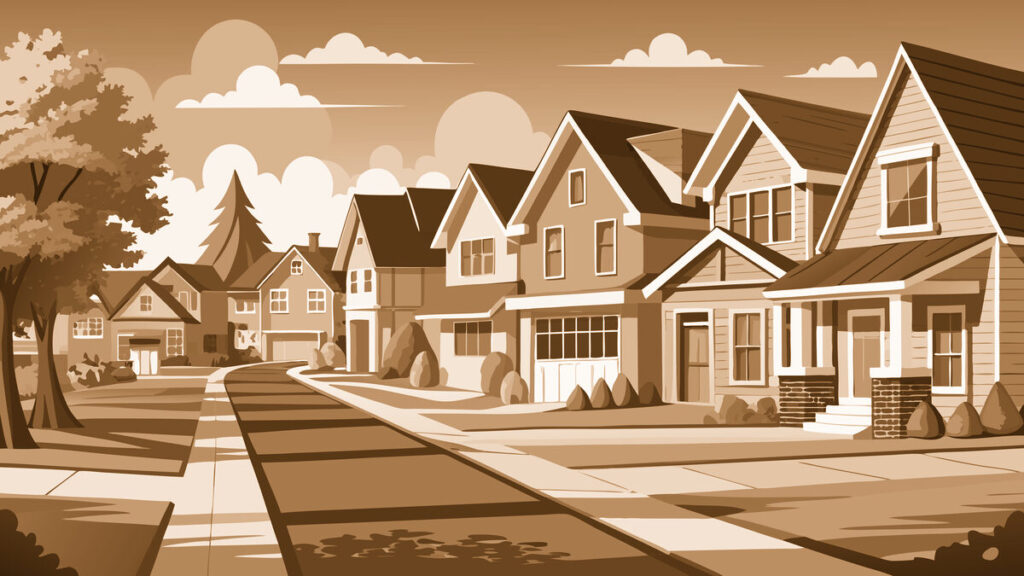
A Neighborhood Built on Strongsville’s Expanding Story
Huntington Park Estates is one of those Strongsville neighborhoods that feels established without feeling old-fashioned. Its streets are quiet, its homes are set among mature trees, and its shared spaces give the community a welcoming, lived-in character. Yet the neighborhood itself belongs to a relatively recent chapter in Strongsville history—one shaped by suburban growth, new roads, family housing, and the transformation of former open land into a connected residential community.
The subdivision is located in north-central Strongsville, near Albion Road, Webster Road, Whitney Road, and Interstate 71. Local real-estate descriptions commonly place its entrances and homes around the Albion and Webster Road area, while city records identify a Whitney Road entrance as well.
To understand Huntington Park Estates, it helps to look first at the larger history surrounding it. Strongsville began as a rural settlement in the early nineteenth century, with early development concentrated around Pearl Road, mills, farms, and crossroads communities such as Albion. The Strongsville Historical Society preserves that earlier era through historic homes, agricultural buildings, and other structures gathered in its village complex.
Huntington Park Estates represents the next major stage: the conversion of suburban farmland and undeveloped acreage into a planned neighborhood connected to the growing Cleveland metropolitan area.
The Origins of Huntington Park Estates
The official record shows that Huntington Park Estates emerged during Strongsville’s major residential-building boom of the late 1970s and 1980s. Strongsville City Council accepted the plat for Huntington Park Estates Subdivision No. 1, Phase I, in November 1977. Later phases followed in 1981, 1983, and 1984. Additional Huntington Park sections and related developments were recorded during the mid-1980s.
That timing is significant. By the late twentieth century, Strongsville was no longer simply a rural township on the edge of Cleveland. It was becoming a substantial suburban city, with new subdivisions appearing alongside improved highways, expanded schools, shopping centers, and employment areas. The arrival and expansion of Interstate 71 made the area especially attractive to families seeking larger homes and convenient access to Cleveland, the Ohio Turnpike, and surrounding communities.
Huntington Park Estates grew in that environment. Its development was not a single moment but a gradual process, with streets and sections added over several years. That phased history helps explain why the neighborhood includes a variety of home styles, lot arrangements, and smaller internal areas rather than looking like a community built all at once.
How Did the Neighborhood Get Its Name?
The name “Huntington Park Estates” has a polished, park-like quality that fits the neighborhood’s design, but the surviving public records do not clearly identify the person, family, or specific property that inspired the name. The city’s subdivision records document when the plats were approved, but they do not provide a naming explanation.
The most careful way to describe the name is as a developer-selected identity reflecting the language of late twentieth-century suburban planning. “Park” suggested green space and a pleasant residential setting, while “Estates” conveyed privacy, comfort, and larger homes. Those themes remain visible in the neighborhood today through its commons areas, athletic courts, landscaped entrances, and tree-lined streets.
It is also important not to confuse Huntington Park Estates with Strongsville’s historic Albion settlement or with unrelated places named Huntington elsewhere in Ohio. In Strongsville, the neighborhood name belongs specifically to the residential development recorded beginning in 1977.
Streets That Tell the Story
A walk through Huntington Park Estates reveals how the community developed in sections. Huntington Park Drive serves as one of the neighborhood’s defining streets, while North LaGuardia Parkway is another recognizable address corridor. Other streets and courts branch into quieter residential pockets, reflecting the curving, internally focused design common to suburban subdivisions of the period.
The neighborhood’s relationship with Whitney Road is especially important. Whitney Road connects the subdivision to the broader Strongsville road network and helps place Huntington Park Estates within the city’s north-central landscape. City documents identify work and maintenance along Whitney Road, including the portion running between Pearl Road and Interstate 71.
For longtime residents, these roads are more than addresses. They are part of the daily rhythm of the neighborhood: school mornings, evening walks, holiday decorations, driveway conversations, and the steady transition from new development to established community.
Shared Spaces and Neighborhood Landmarks
Unlike older Strongsville districts centered on a church, village green, or historic commercial street, Huntington Park Estates is defined by its residential landscape and common areas. City architectural review records refer to the neighborhood’s West Commons, Central Commons, and Athletic Courts areas, along with entrance signage at Whitney Road. These shared spaces are modest compared with a regional park, but they help create a sense of place and give the subdivision an identity beyond individual houses.
Nearby Surrarrer Park is another important local amenity. Located at 14625 Whitney Road, at the corner of Webster and Whitney roads, the park provides recreation space close to Huntington Park Estates and reinforces the neighborhood’s connection to Strongsville’s wider park system.
For historical landmarks, residents can look beyond the subdivision to the Strongsville Historical Society’s village buildings and the city’s older civic landmarks. The Pomeroy House, built in 1832 and originally located on Pearl Road in Albion, is a reminder that the land around today’s subdivisions has a much older story.
From New Construction to Established Community
The first Huntington Park homes were part of a period when many Strongsville families were moving from older urban neighborhoods into newly built suburban houses. Over time, the neighborhood matured. Young families became longtime residents, children grew up and moved away, and newer homeowners joined those who had lived there for decades.
The housing stock also evolved. While the original development included traditional single-family homes, later sections and related phases introduced additional layouts and, in some areas, cluster-style living. Real-estate records identify multiple Huntington Park Estates sections, including areas associated with homes built in the 1980s and 1990s.
By 2022, the Strongsville City School District listed Huntington Park Estates as a 251-unit single-family neighborhood assigned to Whitney Elementary School. That figure illustrates the community’s substantial size and continuing role in the city’s family-oriented residential landscape.
Today, Huntington Park Estates feels less like a new subdivision and more like a settled neighborhood with layers of memory. Its trees have grown taller, its houses have been updated and remodeled, and its common spaces have become familiar gathering points. The neighborhood has changed, but its central appeal remains much the same: convenient roads, comfortable homes, nearby recreation, and a strong connection to the everyday life of Strongsville.
What Makes Huntington Park Estates Special
Huntington Park Estates does not preserve history through a row of nineteenth-century buildings. Instead, it preserves a different kind of local heritage—the story of how Strongsville grew into a modern suburban city while remaining connected to its rural and village past.
Its history can be read in the dates of its subdivision plats, the names of its roads, the changing appearance of its homes, and the memories of residents who watched empty land become streets and then watched those streets become home. That combination of planned development and lived experience is what gives Huntington Park Estates its character.
For anyone taking a drive along Huntington Park Drive, LaGuardia Parkway, Whitney Road, or the neighborhood’s quieter courts, the setting may appear peaceful and familiar. But beneath that calm is a story of Strongsville’s transformation—one that continues every time a family moves in, a child heads to school, or neighbors gather in the commons on a summer evening.